Banbury: The Square Has Always Traded
A market town whose identity is its market — the crosses, the cake, the canal, and the long argument between commerce and church over who owns the town centre.
A Town Built Around Its Thursday
Banbury's market charter dates to the twelfth century, granted by the Bishop of Lincoln when the town fell within that vast diocese. The bishop's castle sat on a spur above the River Cherwell, and the town grew in its shadow, but it was the market that gave Banbury its lasting shape. The wide market place — never a true square, more a broadening of the main street — was a practical instrument first and a civic gesture second. Stalls filled it on Thursdays; cattle, sheep, grain and cloth changed hands in the space the street provided, and the space the street provided was arranged precisely to accommodate that trade.
The town plan Banbury still follows is medieval in its bones. The parish church of St Mary stands clear of the market place, which is significant: in many English market towns the church and the market grew up cheek by jowl, one lending the other legitimacy. In Banbury, the two were always slightly apart — the market answerable to the bishop as landowner, later to the borough corporation, and always to itself. That independence of commercial character has never quite left.
What did leave, in the 1790s, was the medieval church. Decay had set in and the tower collapsed, and the building was pulled down, having long since been stripped by the town's Puritans — in a campaign against what they called idolatrous imagery. The present St Mary's is an early nineteenth-century rebuilding by Samuel Pepys Cockerell, completed in 1822, a composed piece of Neoclassical work in pale limestone that sits in deliberate contrast to the ironstone warmth of the surrounding district. It is a handsome building in its own terms, but it is not medieval, and visitors who assume otherwise have missed the town's most instructive piece of religious history.
The Cross, the Rhyme and the Cake
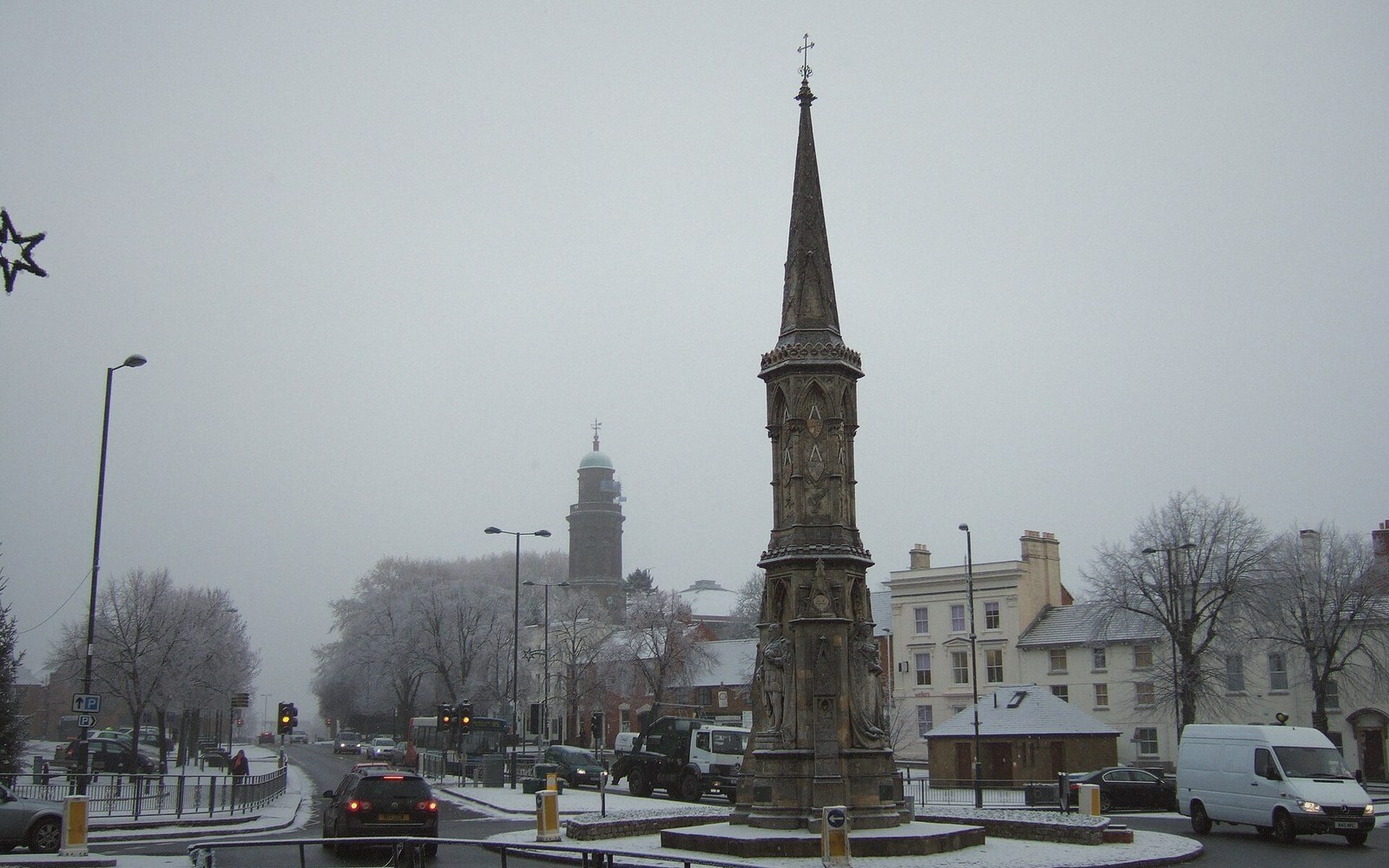
The nursery rhyme about Banbury Cross is older than its subject. The cross the rhyme names — to Banbury Cross to see a fine lady — was a preaching cross in the market place, and it met the same fate as much else in the town during the seventeenth century: it was pulled down by the Puritans, who were powerful here and who objected to the crosses as monuments to superstition. The cross that stands today at the junction of Horse Fair and the High Street is a Victorian replacement, erected in 1859 to mark the marriage of the Princess Royal. It is gothic in feel, decorated with figures of Queen Victoria, Edward VII and George V, added in 1914 to mark George V's coronation. None of this appears in any nursery rhyme because the rhyme predates the present structure by centuries.
The cake is real, though different from what most people expect. Banbury cake is a flat, oval pastry filled with dried fruit — currants principally, spiced, held in a short pastry that is closer to rough puff than to shortcrust. Recipes appear from at least the early seventeenth century, making it one of England's older recorded regional baked goods. A shop on Parsons Street sold Banbury cakes for well over a century from the same premises; the trade has changed hands and premises since. The cake persists, which is the point: it is a commercial product, not a heritage project, and it has survived because people buy it.
- —Medieval church demolished 1602 by Puritans; tower taken down first
- —Replacement St Mary's built to Cockerell's design, completed 1822
- —Victorian cross erected 1859; commemorates marriage of Princess Royal
- —Oxford Canal reached Banbury 1778, twelve years before reaching Oxford
- —GWR branch arrived 1852
- —Castle Quay phase two completed 2021
What the Canal Brought In
The Oxford Canal arrived at Banbury in 1778, eleven years before it reached Oxford, and its effect on the town's economy was immediate and structural. Coal from the Warwickshire pits — Griff, Bedworth, and the Coventry coalfield — could now move south without the ruinous expense of road haulage. The canal wharf sat north of the town centre, and the industries that grew around it were the heavy, unglamorous trades that cheap bulk transport enables: lime burning, ironworking, milling. Banbury had always processed agricultural produce; the canal allowed it to import raw materials and export manufactured goods at scale.
Local ironstone gave builders their material, but the ironstone itself was never the industrial story here — that belongs to the ironstone workings elsewhere in the district. What the canal changed in Banbury was the availability of coal, and coal changed what was possible. Foundries could operate at a scale the town had never managed before, and by the early nineteenth century Banbury had become a modest but genuine centre of agricultural engineering. Samuelson's, founded in the 1840s, made reaping machines and other agricultural implements that were exported internationally. The works stood close to the canal; later, they stood close to the railway as well.
The Railway and the Town It Made
The Great Western Railway reached Banbury in 1852, on a branch from Didcot; the Great Central line arrived later, giving the town a second main-line connection. The effect on the market was double-edged. Cattle and livestock could now arrive by train from far further away, enlarging the market's effective catchment and making Banbury's Thursday cattle market one of the largest in England by the mid-twentieth century. But the same railway that filled the market also connected consumers to distant suppliers, and the old pattern of the town as the sole commercial centre for a wide agricultural hinterland began, slowly, to shift.
The Great Western Railway reached Banbury in 1852, on a branch from Didcot; the Great Central line arrived later, giving the town a second main-line connection.
The physical layout of the railway reinforced the town's already dual character. The station sat east of the town centre, across the Cherwell — the canal already occupied a corridor to the north. Between them, industry settled in the low ground near the river, while the market place and the retail town continued on the higher ground to the west. That separation is still readable in the townscape: the older commercial grain of the High Street, Parsons Street and the market place contrasts with the industrial grain of the canal corridor and the Cherwell plain below.
The Market Now
Banbury market still runs on Thursdays and Saturdays in the market place, which means it has traded on at least one of those days in most weeks for the better part of nine centuries. The stalls are different — the livestock market moved out of the town centre long ago, as it did in most English country towns when food regulation and vehicle access made street trading in cattle impractical — but the weekly rhythm has not broken. A permanent indoor market occupies the Castle Quay shopping development, which replaced the old mill and canal basin area from the 1990s onwards. Castle Quay extended to a second phase in 2021. The irony that a retail mall now occupies the canal wharf that industrial trade built is the kind of irony that Banbury, a pragmatic town, has absorbed without ceremony.
What the market place still does is hold the town together spatially. English town centres that lost their markets often lost their centres in any meaningful sense — the function dispersed, the public space became residual. Banbury's weekly markets have kept the gravity of the place in the right spot. The layout the medieval bishop's borough established — wide enough to trade, anchored by the church to one side and the high street to the other — has proved robust enough to absorb a Victorian cross, a Neoclassical church, a canal wharf, a railway, and a shopping centre without losing its essential argument. It is still a market town in its bones, which is to say it is still organised around the idea that people come to a particular place on a particular day to buy and sell things. That is the oldest and most durable reason for a town to exist.