Chipping Norton Was Built on Wool
The highest town in Oxfordshire earned that elevation through trade. For two centuries it was one of the wealthiest wool markets in England, and the buildings that survive explain why.
The Market and the Fleece
Chipping Norton sits at around 650 feet on the edge of the Cotswold plateau, exposed to every wind that crosses the wolds from the west. The name announces its purpose: chipping derives from the Old English ceap, meaning market, the same root that gives us Chipping Campden and the surname Chapman. A market charter was granted in 1205, and for the next three centuries the town grew rich on a single commodity — raw wool, clipped from the sheep that grazed the limestone uplands in every direction.
The Cotswolds in the medieval period produced wool of exceptional quality, and north Oxfordshire sat at the eastern edge of that economy. Merchants here handled clip from flocks that ran across the plateau and down into the Cherwell valley, selling it on to buyers who would move it to the weaving towns of the Low Countries. The town's position mattered: high enough to be defensible and prominent, close enough to the drove routes that connected producer to market. Prosperity was not accidental — it was geographical.
What the Money Built
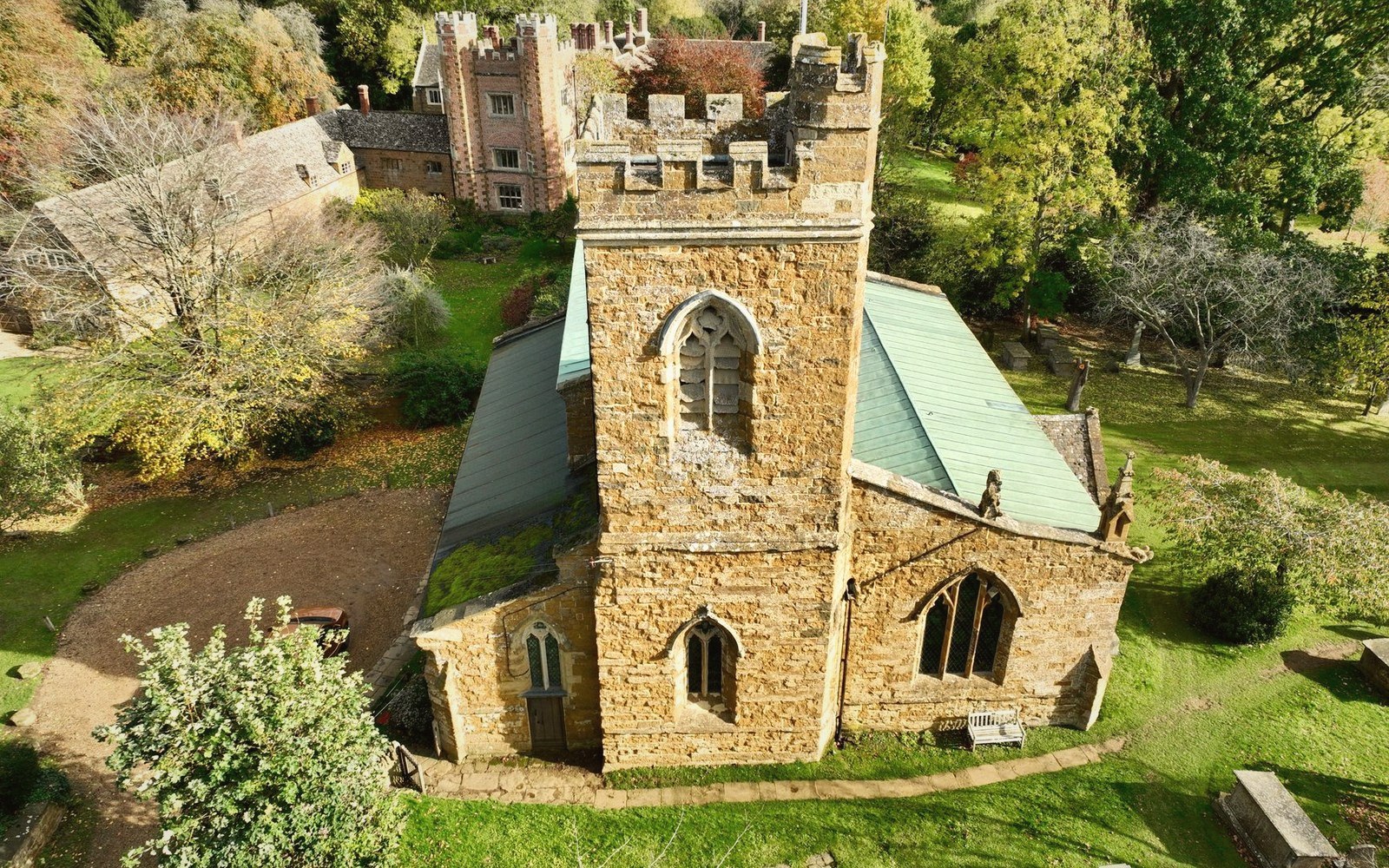
The church of St Mary the Virgin tells the story more plainly than any document. It stands at the edge of the market place, and its Perpendicular nave, rebuilt in the fifteenth century, is out of all proportion to the town's current size. Perpendicular Gothic — the English style characterised by large windows, flattened arches and an emphasis on vertical lines — was the architectural language of mercantile ambition in the wool counties, and St Mary's speaks it fluently. The clerestory is unusually tall; the nave wide. This was not a building put up by subsistence farmers. The hexagonal south porch, an unusual and expensive feature, is a further signal of disposable wealth looking for a lasting form.
The churchyard looks north over a shallow valley where the remains of an earthwork called the castle site can be traced, though little stands above ground. The market place itself retains its long triangular form, a shape common to planned medieval markets where the width allowed stalls to set up down the centre while through traffic continued around the edges. Several of the buildings around it were refaced in later centuries, but the underlying plot pattern preserves the medieval layout.
The Mill and the Later Town
Wool wealth began to drain away in the sixteenth and seventeenth centuries as the trade reorganised around cloth-making towns with faster-moving water and cheaper labour. Chipping Norton contracted, and for two hundred years it was prosperous enough but no longer remarkable.
Chipping Norton contracted, and for two hundred years it was prosperous enough but no longer remarkable.
Then in 1872 William Bliss's tweed mill was rebuilt in a form that makes it unmistakable. The Bliss Tweed Mill stands at the western edge of the town, in the valley below the market place — a Victorian factory dressed in a Baroque idiom, with a tall chimney rising from a domed engine house and a symmetrical façade that would not embarrass a country house. The architect was George Woodhouse, and the building is frankly theatrical: a deliberate statement that manufacture here aspired to something more than utility. The mill drew workers, required housing, and pulled the town's centre of gravity downhill toward the valley floor. Production at Bliss Mill eventually ceased in 1980, and the building has since been converted to apartments — but its silhouette remains the thing most visitors photograph, and it is genuinely worth the detour.
The town today carries both phases of its past without much obvious tension. The church and the market place represent the wool economy at its height; the mill represents the attempt to recover industrial relevance four hundred years later. Between them, the streets of Georgian and early Victorian terracing represent the quieter middle period, when Chipping Norton was simply a comfortable Oxfordshire market town living off remembered importance. All three layers are readable from a single morning's walk, which is as good a reason as any to come.
- 1205market charter granted
- 15th centurySt Mary the Virgin nave rebuilt in Perpendicular style at the height of the wool economy
- 1872Bliss Tweed Mill rebuilt to designs by George Woodhouse
- 1980production at Bliss Mill ceases