Deddington and the Castle That Went
Earthworks where a castle stood, a market square that outlived the market's importance, and what a town looks like when its reason for existing is removed.
The ruin that isn't there
Deddington sits at a kind of pause in the north Oxfordshire landscape — higher than the Cherwell valley to its east, open to the wind, built in the warm rust-brown ironstone that runs through every village in this district. It has the shape of a town and the population of a village, and the reason for that mismatch is buried in the field at the south end of the main street: a set of grassed-over earthworks, barely legible without knowing what to look for, that mark where a castle once organised the whole settlement around itself.
The earthworks are substantial if you read them carefully — a roughly rectangular enclosure with clear banks and ditches, the platform of a former keep still visible as a raised area within. The castle they describe was built in the years after the Norman Conquest, almost certainly in the eleventh or early twelfth century, and at its height it was a significant structure: a stone keep, towers, a gatehouse. For a period Deddington was a place of genuine regional weight, its market and fair operating under the commercial shelter that a castle presence reliably provided. Piers Gaveston, Edward II's controversial favourite, was seized here in 1312 — intercepted at the castle by the Earl of Warwick's men — which gives some measure of how the place registered in early fourteenth-century political geography.
Why the town stayed when the reason left
By the late medieval period, the castle was already decaying. It had no permanent garrison and no sustained royal interest, and stone robbing — the efficient medieval habit of dismantling unwanted buildings for their ready-cut material — did the rest. The castle effectively disappeared. What remained was the town that had grown up to serve it: the wide market square, the church of St Peter and St Paul with its substantial tower, the burgage plots whose long thin proportions you can still trace in the rear boundaries of the properties facing the square.
The church is worth pausing over. It is largely fourteenth-century work, built at a scale that implies real ambition and real money — the kind of investment that follows an established market, not a failing one. The castle was already in decline when much of what you see was built, which suggests that Deddington's commercial life had become self-sustaining, the market outlasting the military reason for holding one here in the first place.
It is largely fourteenth-century work, built at a scale that implies real ambition and real money — the kind of investment that follows an established market, not a failing one.
That market continued, formally, for centuries. Deddington had a charter and a fair and a square large enough to accommodate serious trading. But the town never grew to match its infrastructure. The arrival of the turnpike roads in the eighteenth century and then the railways in the nineteenth favoured Banbury, six miles north, which had better valley connections, a larger catchment and a canal already threading through it. Deddington found itself on the road between places rather than being one of them.
What a residual town looks like
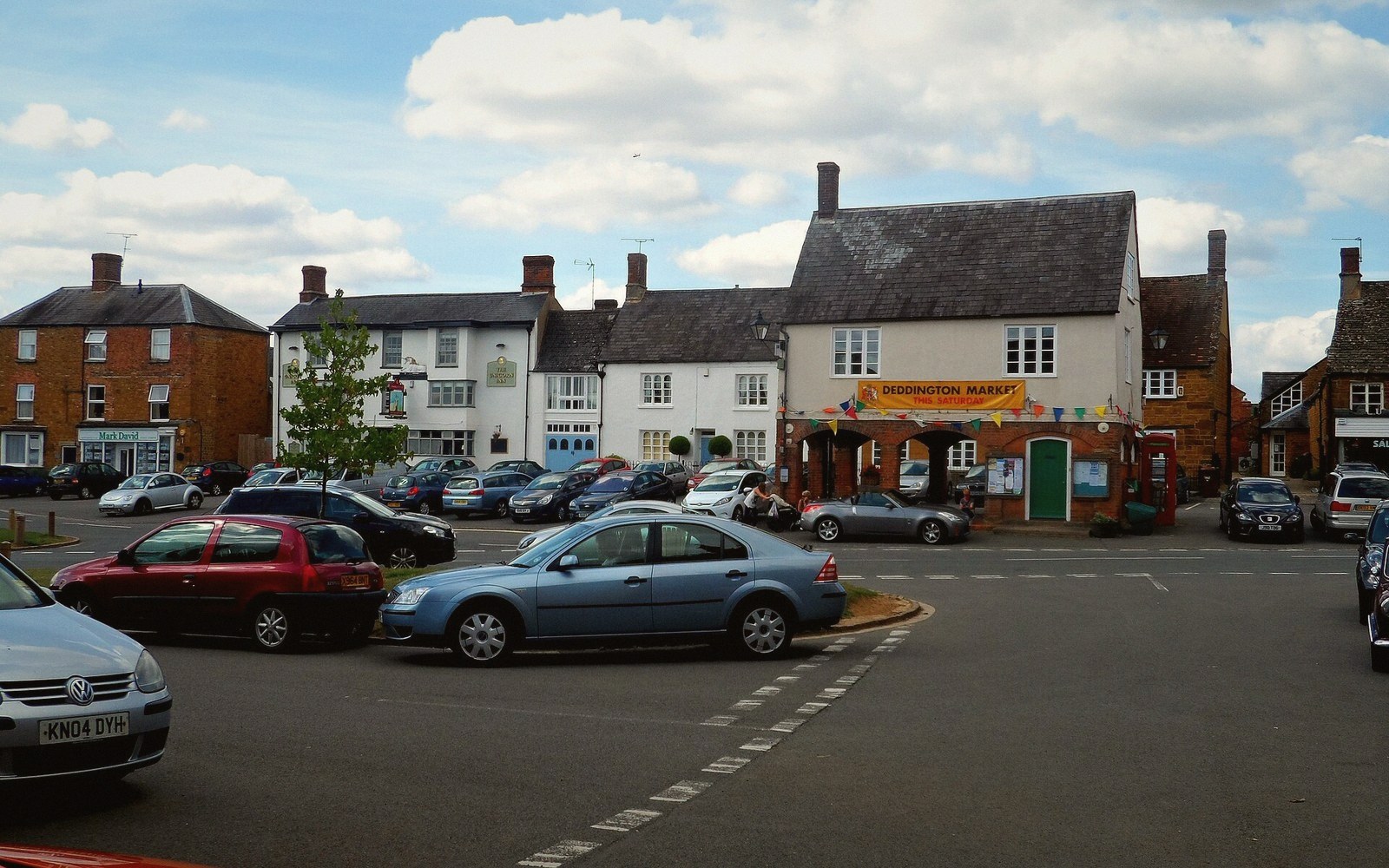
The result is a settlement that reads, spatially, as something larger than it functionally is. The square is genuinely big — bigger than any current weekly need would justify — and the surrounding streets have the proportions of a place that expected more traffic than it gets. This is not decline so much as arrested development: Deddington reached a certain size, lost the economic drivers that would have pushed it further, and then stayed. Its buildings are largely Georgian and earlier, because there was not enough subsequent pressure to replace them. The ironstone fabric is consistent and handsome precisely because no Victorian commercial boom arrived to insert brick-fronted shops.
The earthworks in the southern field are, in this light, the most instructive thing in the village. They are not a picturesque ruin. They are an explanation — of the market square, of the church's ambition, of the gap between the town's form and its current scale. Deddington looks the way it does because something important happened here, and then stopped.