Cut Green, Weathered Brown
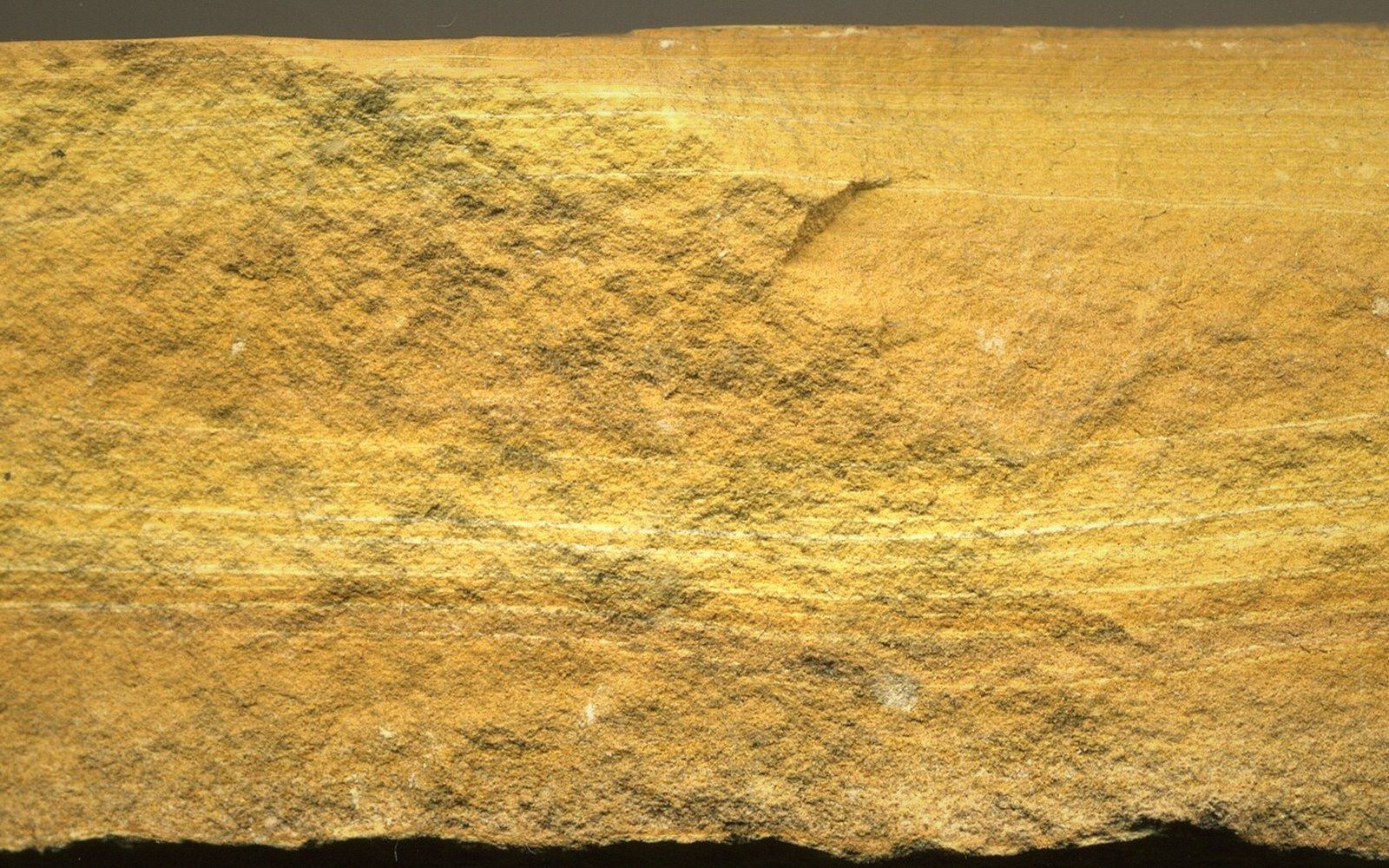
Marlstone comes out of the ground a pale green-grey and turns rust-brown in the air as its iron oxidises. The district's colour is a chemical event, still happening on every wall — and it explains why old and new stonework never quite match.
The colour is a reaction, not a pigment
Stand beside any old wall in north Oxfordshire — in Deddington, in Bloxham, in any of the ironstone villages strung along the Cherwell valley — and you are looking at a chemical process, not a decorative choice. The warm rust-brown that gives the district its particular character, that low, ferrous glow in slanting afternoon light, is the product of iron meeting oxygen. The stone was never that colour when it was cut.
Marlstone, the ferruginous limestone that underlies much of this district, comes out of the ground a pale green-grey — sometimes greenish-buff, sometimes almost the colour of old pewter. Quarrymen knew it; anyone who has watched a freshly opened face in one of the district's small workings would have seen it. The colour belongs to iron compounds in their reduced state, chiefly iron silicates, held in a rock that has been sealed from the air since it was laid down in shallow Jurassic seas, roughly 180 million years ago. Expose those compounds to oxygen and moisture and the chemistry changes. Iron silicates oxidise into iron oxides, the same family of compounds responsible for rust on steel, for ochre in soil, for the colour of the Sahara. The stone blushes, deepens, and within a few years of exposure settles into the characteristic brown-orange that defines every village in the belt.
This matters for understanding what you are seeing on any wall, because the colour is not uniform. It is a record of exposure. Deep in the mass of a thick wall, protected by its own bulk, the stone may remain greener and paler for decades. At the surface, the oxidation runs quickly. The long-weathered outer face of a church tower, centuries old and iron-dark, is simply further along the same reaction than the pale sill of a window replaced in living memory. Old and new stonework never quite match, and cannot, because they are at different stages of the same irreversible process.
How the quarryman and the mason worked with this
The transition from green to brown is not merely a slow drift that happens on the wall. Some of it happens fast — measurably so in the weeks after fresh stone is exposed. This was practically useful information. A mason working with newly quarried marlstone was handling material that was slightly softer, more workable, than the same stone after a year in the air. The iron oxides that form on and near the surface create a harder skin, a weathering crust, which the trade sometimes called the quarry crust or natural bed. Masons knew to dress and shape the stone before that crust fully hardened. Work it green, set it in the wall, and let the air do the rest.
This is why you occasionally find decorative carving in ironstone that is finer than the material's reputation might suggest. The stone can be worked with some precision when fresh. It is after setting — after the oxidising surface hardens, and after that hardened surface begins to spall or erode under frost and rain — that its coarser qualities reassert themselves. North Oxfordshire's churches show both ends of this range: crisp original mouldings cut when the stone was tractable, and later repairs in stone that was already part-weathered at the point of use, noticeably less sharp.
This is why you occasionally find decorative carving in ironstone that is finer than the material's reputation might suggest.
The ironstone belt runs roughly north-to-south through the district, tilting gently, and the stone's quality and iron content vary along its length and with depth. Stone closer to the surface tends to be more porous, more frost-vulnerable, and quicker to weather. Deeper beds are denser and more durable. This is why some walls in the district have held their detail well for centuries while others, seemingly of the same period, are badly eroded. It is not always about age. It is often about which bed the stone came from, and how close to the surface that bed was.
What the colour tells you about the wall
Knowing that fresh stone is green and old stone is brown gives you a reading tool when you look at any building in the district. A patch of noticeably paler stone — less orange, greener or yellower in tone — almost always marks an intervention: a repair, a replacement window or doorway, a section rebuilt after some structural event. This is not conjecture; it is chemistry. The replacement stone simply has not had time to catch up. In ten years it will be closer in tone. In fifty, closer still. But even after a century, if the replacement stone came from a different bed, or was cut at a different time, there can be a residual difference that trained eyes can still detect.
This mismatch has been a practical problem for every generation that has tried to repair historic buildings in the district. Every village matches in a broader sense, because they drew on the same local geology, but no two patches of that geology are identical, and fresh-cut stone is always a different colour from what it is repairing. Conservators working on medieval churches have learned to anticipate this; some accept the mismatch as honest and prefer it to staining or painting new stone to force a premature likeness. Others source stone from the same general formation and wait for time to close the gap. Neither approach is wrong; both acknowledge that the colour is not fixed but ongoing.
There is a further complexity. The iron content of marlstone varies — some beds are heavily ferruginous, some less so. Higher iron content means a deeper, redder-brown as weathering proceeds. Lower iron content produces a more yellow-ochre or honey-coloured result, closer to the appearance of some Cotswold limestones. You can see this variation across the district: Deddington's stone has a different tone from some of the villages further south, and the differences in the walls are not simply age or exposure but partly the character of the particular beds being drawn from at the time of building. The transition zone where marlstone meets the oolitic limestone of the Cotswolds — visible in the buildings along that edge — shows this gradient in real time, one village differing from the next in ways that track the underlying geology almost exactly.
Still happening
This is not history. Every wall in the district is still doing it. A dry summer slows the reaction; wet winters accelerate it. Frost exploits the micro-fractures opened by the chemistry and breaks the surface back, exposing fresh stone that then begins the same cycle. The face of an old church tower is eroding and oxidising simultaneously, losing material at the surface and darkening on the new surface exposed beneath. The colour you see on any given morning is a snapshot of a process that has been running for as long as the stone has been out of the ground, and will continue as long as the wall stands.
This is worth holding in mind when the district's architecture is described as timeless or unchanging. The buildings of north Oxfordshire are not static. They are sites of slow, continuous chemistry, and the warm brown that seems so settled, so permanent, so definitively of this place, was never in the stone to begin with. It arrived from the air, and it is still arriving. Cut a block of this stone today and it will be green. Leave it outside and give it thirty years. Then look at it again.