Why Every Village Matches
Ironstone was everywhere underfoot, carts couldn't go far, and so the district built from what it had. The result is a regional uniformity so deep it looks like a design decision.
The Weight of Stone
Before metalled roads and mechanised transport, building stone was not chosen — it was inherited. A quarry more than three or four miles away was, in practical terms, inaccessible for anything as heavy as rubble walling. The cost of carting stone was not just financial; on unmade tracks that turned to mud in winter, it was a question of whether a loaded wagon could move at all. So the builders of north Oxfordshire built from what was close, and what was close, almost everywhere in the district, was ironstone.
The marlstone — more precisely, the ferruginous limestone of the Middle Lias — outcrops in a broad belt running diagonally through this part of the county, from the Warwickshire border down through Banbury and south towards the Cherwell valley. It lies close to the surface across dozens of parishes. A farmer digging a drainage channel, a builder laying foundations, a landlord clearing a field corner — all of them hit stone within arm's reach. That proximity, replicated across a landscape the size of a county district, produced something no architect planned: a palette.
The Economics of Uniformity
The economics were simple and inescapable. Stone that cost nothing to quarry and very little to cart would be used for everything — barns, cottages, boundary walls, church towers, manor houses. Stone that required payment and effort would be reserved for detailing: a window mullion in a paler limestone, a doorstep in harder material hauled from somewhere else for the purpose. The mass of any building would be local ironstone, and because this was true in Bloxham as in Hook Norton, in Deddington as in Great Tew, the villages came to look alike not through any cultural intention but through shared geology and identical economics.
This is the meaning of regional vernacular architecture. It is not a style in the way that Georgian or Gothic Revival are styles — adopted, codified, sometimes imitated across distances. It is a material truth. The ironstone belt is a geological fact that the building tradition simply followed, and the uniformity it produced is best understood as an economic fingerprint rather than an aesthetic programme.
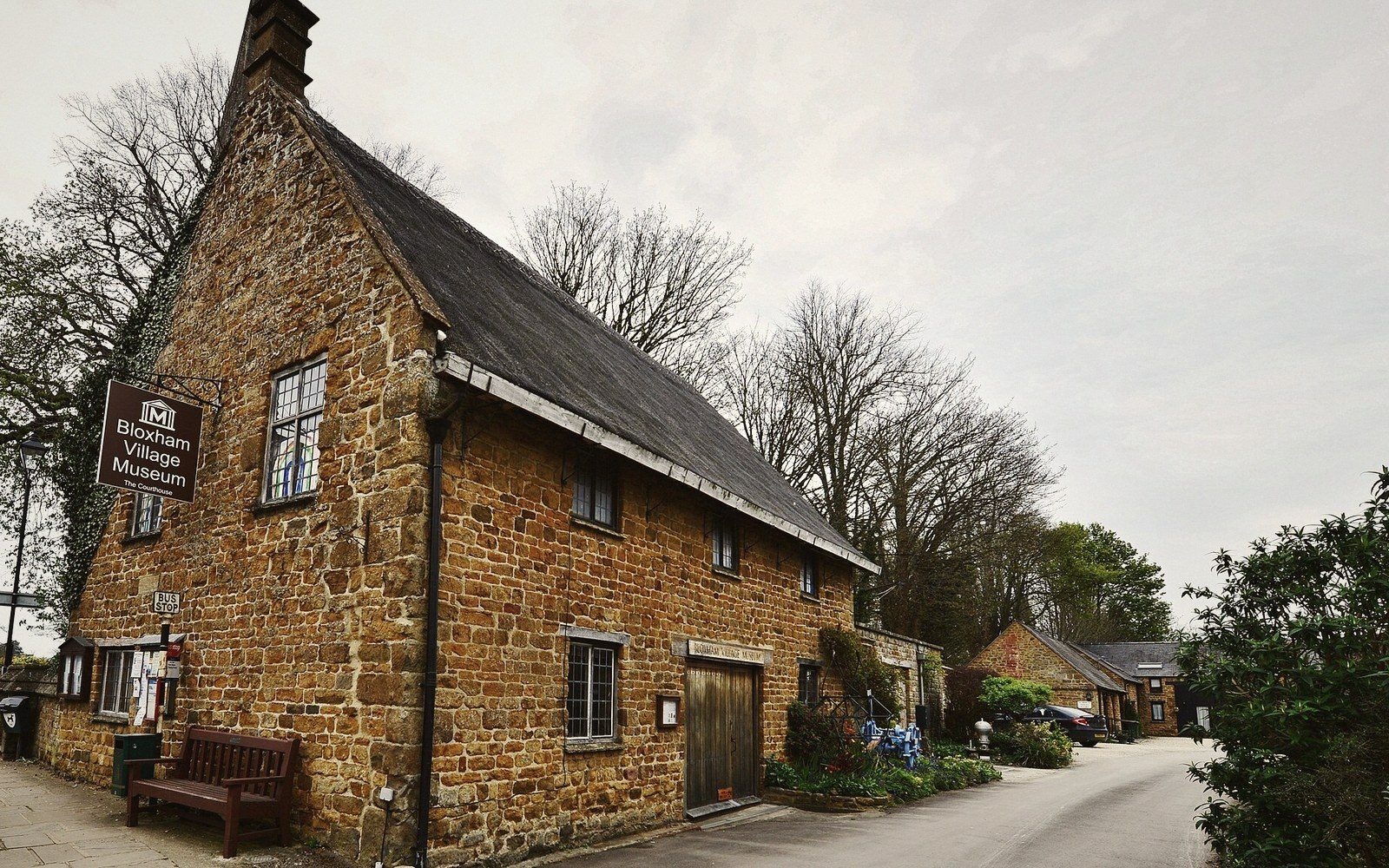
The results are visible in the grain of every village. Walls are not smooth ashlar; they are coursed rubble, sometimes roughly squared, the surface alive with variation because the stone was worked quickly and locally rather than dressed in a yard for a distant client. The colour shifts from orange-brown to a deeper rust depending on the depth of the bed and the degree of weathering. Cut fresh from the quarry, the stone is a pale greenish-grey; within months of exposure, the iron minerals oxidise and the wall turns the warm brown that reads, from a distance, as the colour of the district itself.
The colour shifts from orange-brown to a deeper rust depending on the depth of the bed and the degree of weathering.
Why the Exceptions Stand Out
The exceptions are as instructive as the rule. Where a building departs from ironstone — a Victorian church with Bath stone dressings, a Georgian front in dressed limestone — it is usually signalling either wealth or access to new transport. The Oxford Canal, completed through this part of the county in the 1770s, made it possible for the first time to bring stone in from elsewhere at tolerable cost. Banbury's grander Georgian commercial buildings reflect that access. Later, the railway made the calculation easier still, and Welsh slate began replacing Stonesfield slate on rooftops that could now be reached from a station yard.
But even with the canal and then the railway, most villages were too far from a wharf or goods yard to make importation economic for ordinary building. The cottage going up in 1830 in a village three miles from water used the same ironstone that had built the church 400 years earlier. The continuity reads as tradition; the mechanism was freight cost.
That is why the district has a face — consistent, warm, unmistakably itself. Not because anyone chose it, but because the stone was there and moving it was hard.