The Column and the View
A monument is not decoration. In a landscape park, it is an instruction — telling you where to look, how far away things are, and how to feel about the distance.
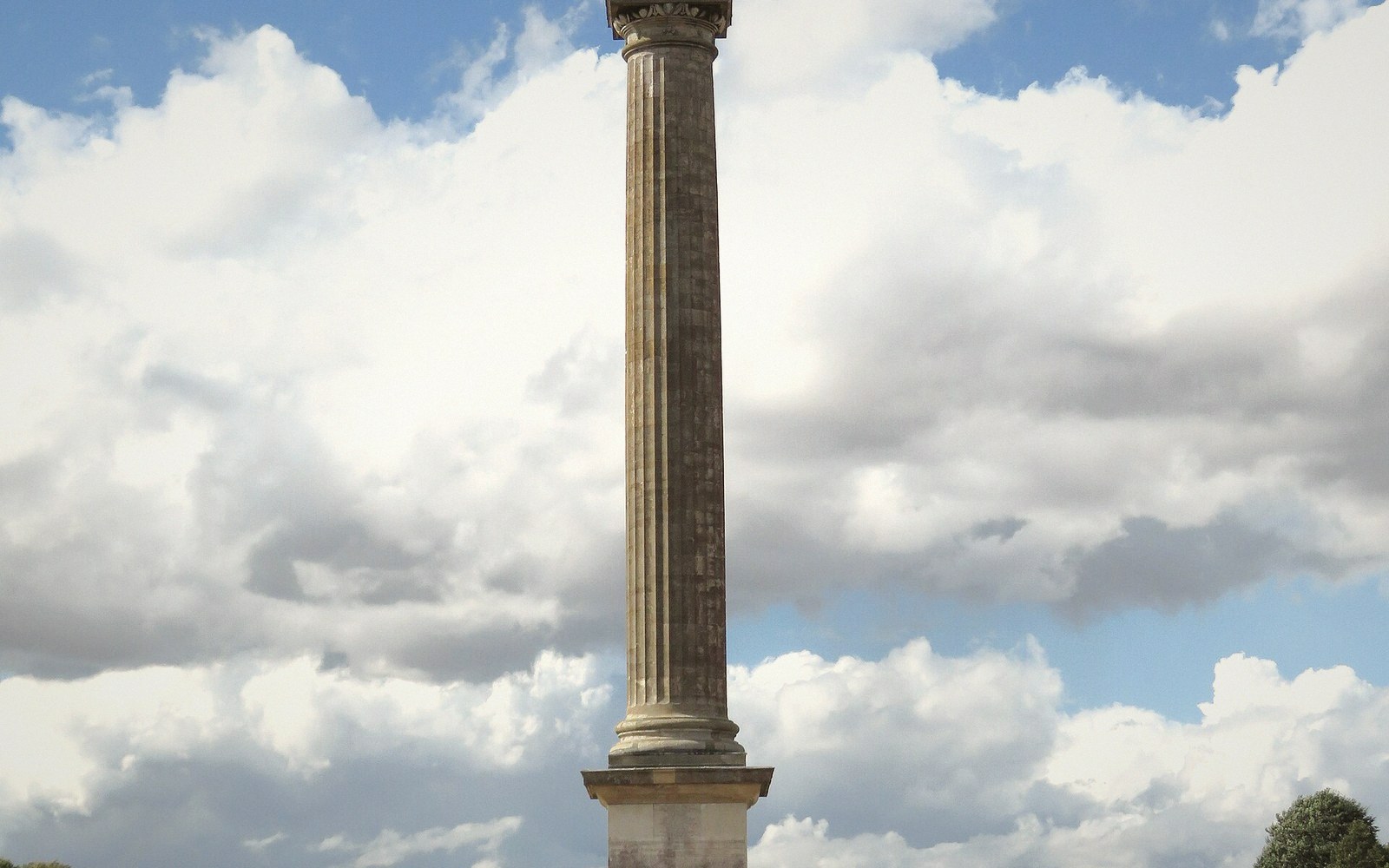
Stone in the Right Place
The Column of Victory at Blenheim stands on a slight rise at the end of a long grass avenue, roughly a mile north of the palace. At its top, a lead figure of the first Duke of Marlborough faces south toward the house he never fully saw completed. The column itself is around 41 metres tall, including the statue — high enough to be visible from most of the park, short enough that it takes a moment's counting of the drum sections before you fully register its height. That gap between first impression and true reckoning is not an accident.
Designed by the Earl of Pembroke with Roger Morris, the column stands within the wider landscape reordering carried out by Lancelot Brown in the 1760s. It predates Brown's lake and his reshaping of the Glyme valley, but it was absorbed into his composition with a fluency that suggests either luck or — more likely — Brown's uncommon ability to work with what was already there. In the designed landscape as it now stands, the column operates as a fixed point of triangulation. Stand at the palace's north front or on the Grand Bridge and the column terminates the view. Stand at the column and the palace fills the southern horizon, framed by trees. Walk between the two and you are walking a sight line that was engineered to feel inevitable.
What Designed Views Actually Do
A designed view works on a principle that is simple once you see it and invisible until you do: scale is legible only when you have something to measure against. An open field of grass tells you almost nothing about its own size. Put a column at one end and a palace at the other, and the ground between them becomes measurable. Your eye travels the distance and your body reads it as long or short depending on what the landscape does in between.
At Blenheim, the middle ground is largely empty by design. Brown cleared, levelled and turfed the approach so that nothing interrupts the eye's transit between the monuments. The effect is that both the palace and the column read as larger than they would in a more cluttered landscape — the emptiness magnifies them both. This is a trick that depends on restraint, which is why Brown's landscapes look simple and are not.
The lake compounds the effect from a different angle. Brown's damming of the Glyme created a broad expanse of water that the Vanbrugh bridge now spans — a bridge that was designed for a narrower river and consequently looks, from the right viewpoints, almost absurdly grand. The water around it is the measure. When the lake was shallow and smaller, the bridge looked merely large. When the lake rose to near the bridge's soffit, the bridge looked monumental. Raising the water level was, among other things, an act of art criticism.
The Grammar of Park Monuments
The Column of Victory is the most prominent of the park's monuments, but it is not the only one that organises space. The park contains temples, cascades, a Grand Bridge, and planted belts of woodland that channel views rather than block them — the difference being that a belt allows carefully managed glimpses while enclosing the visitor within a sequence. This is the grammar of the English landscape park: you move through a series of composed pictures, each one replacing the last, each one calculated to work from a specific position along a path.
The Column of Victory is the most prominent of the park's monuments, but it is not the only one that organises space.
The vocabulary was inherited partly from seventeenth-century Italian landscape painting — Claude Lorrain and Gaspard Dughet in particular, whose paintings arranged trees, water, ruins and light into compositions that British aristocrats on the Grand Tour consumed with reverence and then commissioned their gardeners to reproduce in turf and stone. The English park is, in this sense, a painting made walkable. The column is the ruin that anchors the middle distance; the palace is the inhabited foreground; the sky and the lake fill the rest.
What this means for anyone walking the park today is that the experience has been pre-composed. You are not discovering views; you are receiving them. The designed landscape controls which features are visible from which positions, which paths offer the long axis and which the lateral one, and where the trees close in to reset the picture. Understanding this does not diminish the experience — it clarifies it, the way knowing the key of a piece of music clarifies what the melody is doing. The column does not stand in the landscape. It stands in a sentence, and the park is the rest of the grammar.
The first Duke never saw the landscape whole. Construction on the palace ran until after his death, and the great reordering of the grounds came some forty years later. The column was erected by his widow Sarah, who had complex feelings about the duke, the palace, the architect Vanbrugh, and the Whig politics that had funded and then withdrawn from the project. She placed the monument at the end of the avenue before Brown gave the landscape its present structure. That it fits so perfectly into a composition she never intended is either a tribute to Brown's skill or a reminder that, in a landscape built to last centuries, the designer and the monument rarely share the same moment.