Locks, Bridges and the Lift Bridge
The standard structures of the Oxford Canal, including its distinctive wooden lift bridges, and what each one tells you about the money available when it was built.
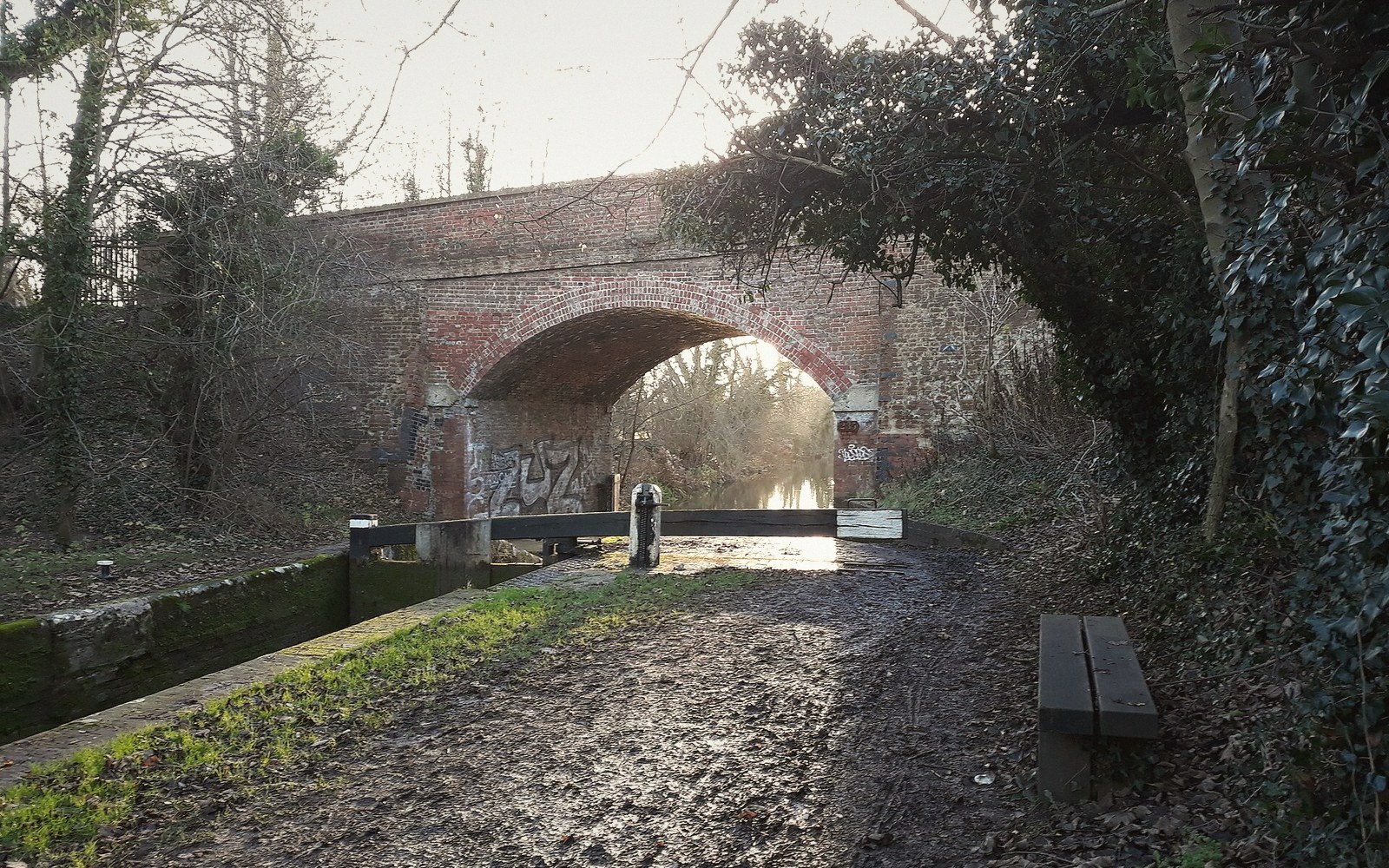
The Canal's Architecture Is Its Account Book
Every lock, bridge and crossing on the Oxford Canal is a record of a decision about money. Where the proprietors could afford masonry, they built it. Where they could not, they built wood. The pattern has never quite disappeared: you can still read the canal's financial history in the structures that carry roads over it, and in the devices that let farmers reach their fields.
The canal opened in stages between 1774 and 1790, and it was never a rich undertaking. The engineer James Brindley laid out the original northern section before his death in 1772; his successor Samuel Simcock completed the work south to Oxford. Brindley's approach — following contour lines rather than cutting through the land — kept earthworks to a minimum, which saved money but produced a sinuous line of extraordinary length. The route from Coventry to Oxford runs to around 77 miles, roughly half as far again as a crow would need. Every extra mile was an extra mile of bank to maintain, gates to replace and structures to keep standing. Economy was not a preference; it was a condition of survival.
What a Lock Is Doing
A lock equalises the level between two stretches of water. The Oxford Canal's locks are narrow — built for boats no more than seven feet wide — and most of them are fairly shallow by the standards of the national system. Shallow locks are faster to fill and cheaper to build; they also waste less water with each use, which mattered on a canal fed by modest Midland streams rather than a reliable upland reservoir.
Somerton Deep Lock is the exception that proves the rule. Sitting where the canal must accommodate a significant fall in the landscape, it is one of the deepest narrow locks on the system, and the additional wear on its gates and the additional water it consumes with every passage made it a perpetual concern for the company's engineers. Most of the Oxford Canal's locks, by contrast, are modest structures of local ironstone or brick, with the familiar balance beams of oak extending back over the towpath to give the boatman enough leverage to push a heavy gate against a head of water.
The Bridge That Doesn't Cross — It Lifts
The structure most specific to this canal, and most legible as a cost-saving measure, is the wooden lift bridge. Where an accommodation bridge — a crossing built to maintain a landowner's access to fields severed by the canal's cut — needed to carry only farm traffic, the company frequently chose a counterbalanced timber platform rather than a masonry arch. The principle is simple: a wooden deck, hinged at one end and counterweighted at the other, can be raised by a single person to allow a boat to pass, then lowered again. No arch, no abutments, no dressed stone.
The structure most specific to this canal, and most legible as a cost-saving measure, is the wooden lift bridge.
These bridges are not elegant in the way that a humpbacked packhorse bridge is elegant, but they have a logic that is easy to admire. The counterweight does most of the work; the operator, in the working canal's day, would be a boatman's mate or a lock-keeper's child. The structure could be built and, crucially, replaced without skilled masons and without substantial capital. When the timber rotted — as it regularly did in a waterside environment — a new one went up on the same ironwork pintles.
What the lift bridge also reveals is the deal between the canal company and the landowners whose land it crossed. The company was legally obliged to maintain access; it met that obligation at the lowest cost consistent with function. That parsimony is now what makes these bridges distinctive. Canals engineered with greater capital — the Grand Junction to the east, opened 1805 — built in brick and stone as a matter of course. On the Oxford Canal, wood and ingenuity stood in for money.
The result is a corridor of structures that looks improvised, because in economic terms it was. Walk the towpath and you are walking through a set of choices made under financial pressure two and a half centuries ago; the lift bridge, creaking on its pivot, is still making the argument.
- 1772James Brindley dies; northern section of the Oxford Canal already under way to his contour-following design
- 1774–1790canal opens in stages, Coventry to Oxford
- 1805Grand Junction Canal opens, built to a more capitalised standard with masonry structures throughout