Somerton Deep Lock
Where the canal cashes in a long level — and why the whole summit-to-junction geometry makes this single chamber unavoidable.
How a Lock Works Against a Canal
A canal is, at its simplest, a chain of level ponds. Each lock is the price the water pays to move from one level to the next: when you empty a chamber going downhill, roughly a lockful of water — around 25,000 gallons on a narrow canal — slides down with the boat and is gone from the upper reach. Lock the wrong way and you spend water going up. Either way, every movement costs.
Canal engineers had one obvious reason to keep locks few and far between: the more working locks on a summit pound, the faster it drained. So the Oxford Canal's builders on the northern line, working through Oxfordshire in the late eighteenth century under the engineer Samuel Simcock after James Brindley's death, made a virtue of contour-following. By hugging hillsides and wrapping around valleys — adding miles of winding channel — they held level for long stretches, which meant they could bank up the fall and pay it off in fewer, deeper drops rather than many shallow ones. Somerton Deep Lock, south of the village of Somerton and north of Heyford Wharf, is where one of those banked-up payments falls due.
The Lock and What It Does
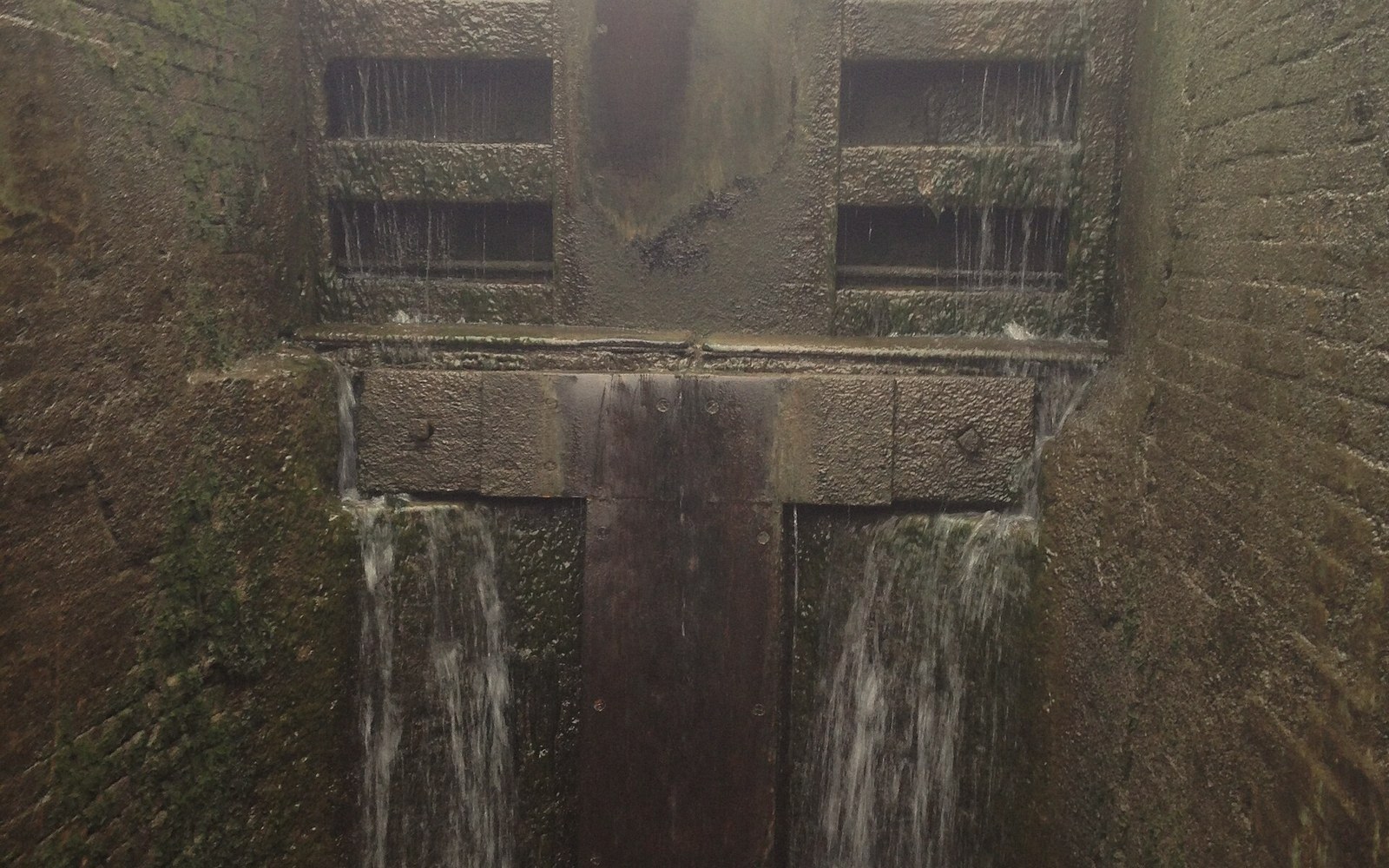
Somerton Deep Lock is among the deepest narrow locks on the entire Oxford Canal. Its fall is approximately twelve feet — roughly twice the drop of a standard Oxford Canal lock, which typically descends five or six feet. That disparity is not incidental: it is the accumulated gradient of the level that precedes it, held in check for miles, then surrendered in a single chamber.
The practical consequence for anyone working a boat through is immediately physical. Filling a deep lock takes considerably longer than filling a standard one; the turbulence as paddles are drawn is correspondingly greater, and a loaded narrowboat in an emptying deep lock descends into something close to a rectangular gorge, with the stone coping of the upper level rising steadily above the gunwales. Coming up from below, the gates ahead look improbable until the water lifts the boat level and the view opens again.
For the canal's water budget, the arithmetic is stark. Each transit of Somerton Deep Lock moves a column of water roughly twelve feet deep across the full chamber cross-section. Because width and length are fixed — narrow locks are standardised — all that extra depth means roughly twice the water per transit compared to a neighbouring standard lock. On a working canal carrying dozens of boats a day in each direction, this was a serious constraint. It pushed the canal company's lengthsmen and reservoir engineers to keep the feeder supply to the adjacent pound properly managed.
It pushed the canal company's lengthsmen and reservoir engineers to keep the feeder supply to the adjacent pound properly managed.
The surrounding countryside explains the geography. The Cherwell valley here is neither flat nor dramatic — it is a mild trough of pasture and alluvium, with low clay ridges to either side, and the canal hugs the valley floor. The fall from the long pound to the north has to be taken somewhere before the canal can carry on down the valley towards Oxford, and the specific relationship between the ridge line and the low land here made a single deep drop more practical than a staircase of shorter ones. Deep locks are also cheaper to build and to operate than staircases of two or three chambers, because a staircase demands even more precise water management — the intermediate pounds between chambers are tiny and drain almost instantly under heavy traffic.
Why This Lock Persists in the Memory
Much of the Oxford Canal north of Banbury was radically shortened in the 1820s when the canal company straightened its line. The contortions that Brindley and Simcock had built — the great loops and bends — were bypassed with new straight cuts. What survived the straightening were the places where the physical fall demanded a structure whatever the route: the locks. Somerton Deep Lock is a place where the same logic applies, even though it lies on a stretch the straightening did not touch. The route may have been adjusted around it over the canal's working life, but the fundamental topographic fact — that the water has to descend here — is non-negotiable. The lock is not a curiosity; it is the landscape's bill, presented to every boat that passes.
Standing at the top gates looking south along the pound, the canal appears to simply end at a flat horizon of water before the fields take over. The depth is invisible from there. Then the far gates come into view, already far below, and the chamber's true scale becomes legible. It is, in miniature, the same geometry that organises all of the Oxford Canal's engineering: a very long patience, and then a single reckoning.